
Some accessories ride a wave for two seasons and vanish. Others barely change across generations. Belts sit in a unique position: the very simplest ones have looked essentially the same since the mid-twentieth century, while trend-driven styles can feel dated within months. This guide introduces a practical framework—the Belt Permanence Test—for evaluating any belt design's staying power, then applies it to the archetypes that pass every criterion.
The Four-Factor Permanence Framework
Before examining individual designs, it helps to define what "timeless" actually means in functional terms. A belt passes the permanence test when it satisfies four criteria simultaneously:
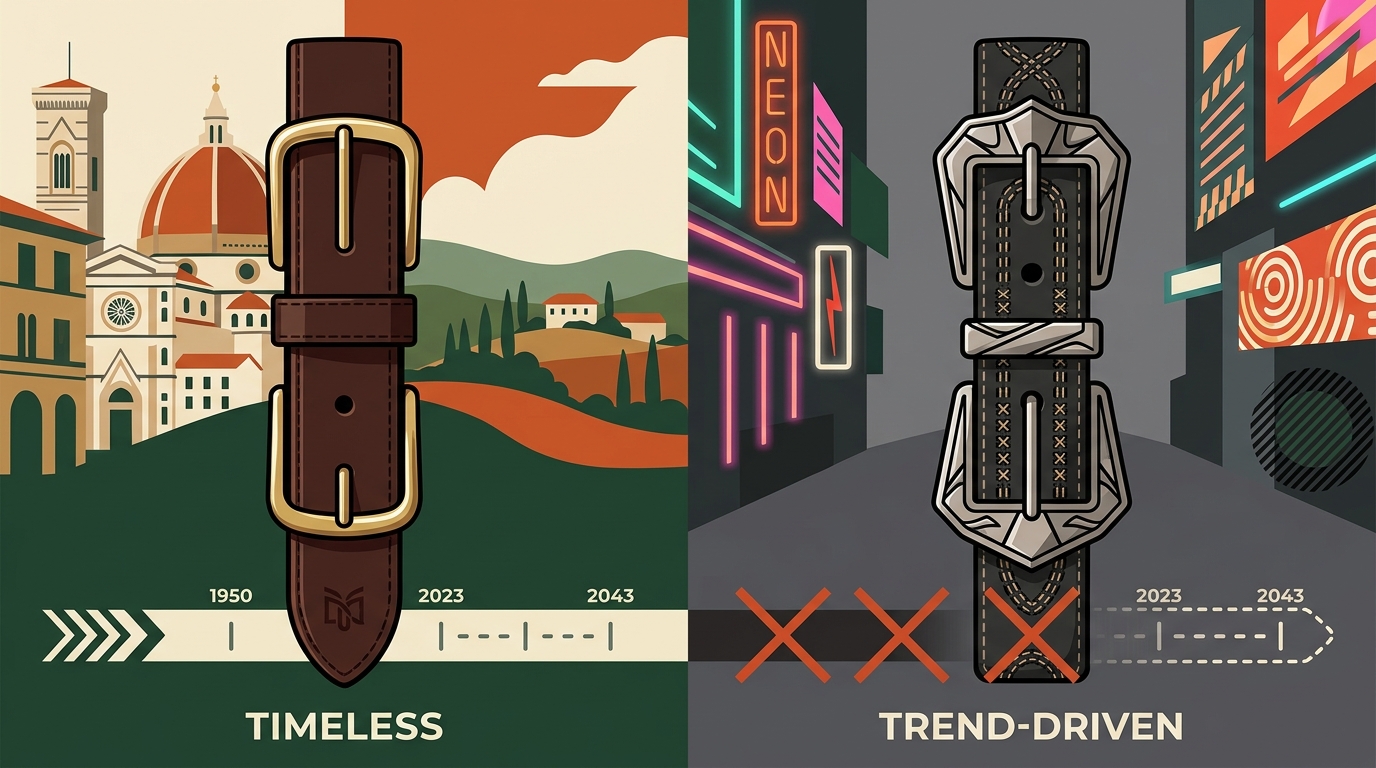
- Era Neutrality — The design cannot be traced to a single decade. If someone can date-stamp it ("that's very 2003"), it fails.
- Gender Fluidity — The proportions work on both men's and women's silhouettes without modification.
- Material Integrity — The belt improves with age rather than deteriorating. Full-grain leather and solid brass hardware meet this bar; bonded leather and zinc-alloy buckles do not.
- Occasion Range — It can move between at least two dress codes (e.g., casual and business) without looking out of place.
Every archetype discussed below satisfies all four factors. Designs that fail even one—oversized logo buckles, neon straps, heavily studded styles—tend to peak and fade within a trend cycle.
Material Longevity: Why Leather Grade Matters More Than Brand
The single biggest predictor of whether a belt will still look good in a decade is its material. A full-grain leather belt is crafted from the entire hide including the robust outer layer, which means it will be the most durable and long-lasting option available. Vegetable-tanned hides are especially prized because they develop a warm patina over years of handling and sunlight exposure rather than cracking or peeling.
Hardware matters equally. Solid brass buckles—even those coated in palladium or silver—resist corrosion and develop a dignified tarnish over time. Zinc-alloy and pot-metal alternatives chip, flake, and expose a dull grey core within a year or two of regular wear. When evaluating any belt purchase, flip the buckle over: a solid brass interior is a reliable sign of quality intent.
Among the most sought-after materials for 2026 and beyond are naturally tanned leather, nubuck, and braided hide—all valued for durability, comfort, and ageless style.
Archetype 1 — The Clean Black Strap
No guide to enduring belt styles is complete without the plain black leather belt. It is widely regarded as the epitome of versatility and elegance, complementing virtually any outfit from office suits to weekend denim. A standard width of roughly 1.5 inches and a traditional frame buckle will never date-stamp an outfit.
The reason this design endures is its total absence of decorative risk. There is no texture, colour gradient, or metalwork that can fall out of favour. The only variable is quality: a poorly made black belt cracks and curls at the edges, while a well-crafted one softens and darkens subtly, its surface becoming richer.
How to Apply the Permanence Test
- Era Neutrality: Pass — a plain black belt has looked the same since at least the 1950s.
- Gender Fluidity: Pass — proportions serve all body types.
- Material Integrity: Pass (if full-grain). Fail if bonded or genuine-grade.
- Occasion Range: Pass — works from boardroom to brunch.
Archetype 2 — The Warm Brown Everyday Belt
Brown leather belts are another essential in any collection. Ranging from deep mahogany to light tan hues, they offer a stylish option equally at home in both casual and semi-formal settings. A medium-brown shade is the most versatile starting point: it pairs with khakis, denim, and earth-toned suits without competing for attention.
Where brown excels over black is in its capacity for patina. Vegetable-tanned brown leather undergoes the most dramatic visual evolution—shifting from a uniform mid-tone to a multi-layered surface that records every crease and touch. For people who value the idea that an accessory should tell a story, brown is the clear winner.
Archetype 3 — The Slim Dress Belt
When it comes to quiet luxury, slim belts immediately come to mind—elegant, sophisticated, and governed by the principle that less is more. Though small in width, they make a strong impact through texture and subtle hardware. A slim leather belt in high-quality leather provides an understated yet sharp appearance, making it ideal for formal occasions, tailored trousers, and pencil skirts.
Classic dress belts usually fall between 1 and 1.25 inches. At this width, the belt recedes just enough to let tailoring do the talking while still providing a finished look. The slim dress belt is one of the few styles that Permanent Style's menswear authority notes makes a surprisingly powerful visual difference even at small width increments.
Archetype 4 — The Wide Waist Belt
Wide belts occupy a powerful place in the silhouette, defining and shaping it in a bold and decisive way. They are excellent for accentuating the waist and can add interest to a monochromatic outfit or create an hourglass shape. For women, a wide belt over a blazer, cardigan, or flowing dress transforms the whole look.
In 2026, wide belts in the 40–60 mm range are firmly in style, worn over coats and dresses to sculpt the waist and command attention. But unlike many current trends, the wide waist belt has deep historical roots—it appeared in 1970s bohemian fashion, 1980s power dressing, and 2020s runway revivals. That recurring presence is itself evidence of permanence.
Archetype 5 — The Woven or Braided Belt
The braided leather belt adds a bohemian touch to casual and smart-casual outfits while remaining subtly elevated. Its woven construction gives any outfit a more relaxed personality, so it transitions well to weekend activities. Unlike a smooth strap, a braided belt lacks fixed holes—you thread the prong between any two weaves—which makes it inherently adjustable and forgiving.
Where braided belts earn permanence points is texture. In a wardrobe of flat, smooth leather goods, the dimensional surface of a woven belt provides contrast without introducing colour or hardware trends. Stick to single-tone leather braids (avoid multi-colour woven fabrics) and the belt passes the era-neutrality test easily.
Archetype 6 — The Subtle Logo-Buckle Belt
A tasteful logo buckle has been a fixture in luxury fashion for generations. The key word is tasteful: subtle branding on quality materials reads as confident, while oversized logos on cheap hardware read as dated. As one style commentator observed, nothing announces a past-its-prime wardrobe quite like a massive designer logo buckle—making restraint the critical variable.
The Hermès Constance H buckle offers a useful benchmark. Its proportions and material quality keep it relevant decade after decade because the design is built on precision rather than logo signalling. The same principle applies at every price tier: a refined monogram in solid brass on full-grain leather will outlast a plated oversized emblem every time.
Archetype 7 — The Reversible Belt
The reversible belt—black on one side, brown on the other—is a practical innovation that has earned staying power through sheer utility. Choose a reversible option for maximum versatility, but ensure the buckle design is refined enough to match both sides. The best versions use a rotating mechanism housed inside a slim, symmetrical frame buckle, so neither colour side looks like an afterthought.
Reversible belts are ideal for travellers and minimalists who want to pack one belt for multiple outfits. They pass the permanence test as long as the execution avoids gimmickry—the mechanism should be invisible when the belt is worn.
Width Decoded: Finding the Right Proportion
Width is the single strongest visual cue a belt sends. A 1.25- to 1.5-inch strap is the most universally flattering width for both men and women—narrow enough for suit trousers, substantial enough for denim. Here is how different widths map to occasions:
| Width | Best Use | Permanence Rating |
|---|---|---|
| Under 1 inch | Formal tailoring, dresses, layering | High (for women); niche (for men) |
| 1–1.25 inches | Dress trousers, smart-casual | Very high |
| 1.25–1.5 inches | Universal everyday | Very high |
| 1.5–2 inches | Casual denim, statement styling | High |
| Over 2 inches | Waist-cinching, outerwear layering | Moderate (cyclical but recurring) |
The Modern Rules of Belt-to-Shoe Matching
For formal and business settings, matching your belt colour to your shoes is still considered a mark of polish. In casual contexts, the rule is more relaxed—tonal harmony matters more than an exact match. Most well-dressed people need a dark brown and a black belt at minimum, with a light brown or tan as an optional third.
The broader shift in 2026 is toward colour as a design element. Deep earth tones—chocolate brown, olive green, petrol blue, terracotta, and sandy beige—are replacing the old black-or-brown binary. Metallic accents in gold and bronze on buckles and trims are gaining ground. These richer palettes remain timeless as long as the hue stays muted; anything neon or hyper-saturated tends to expire quickly.
Why Florentine Craftsmanship Matters
Every archetype in this guide benefits from one underlying truth: craftsmanship pays dividends. Handcrafted belts from heritage ateliers develop character over time and outlast mass-produced alternatives by years—often by decades.
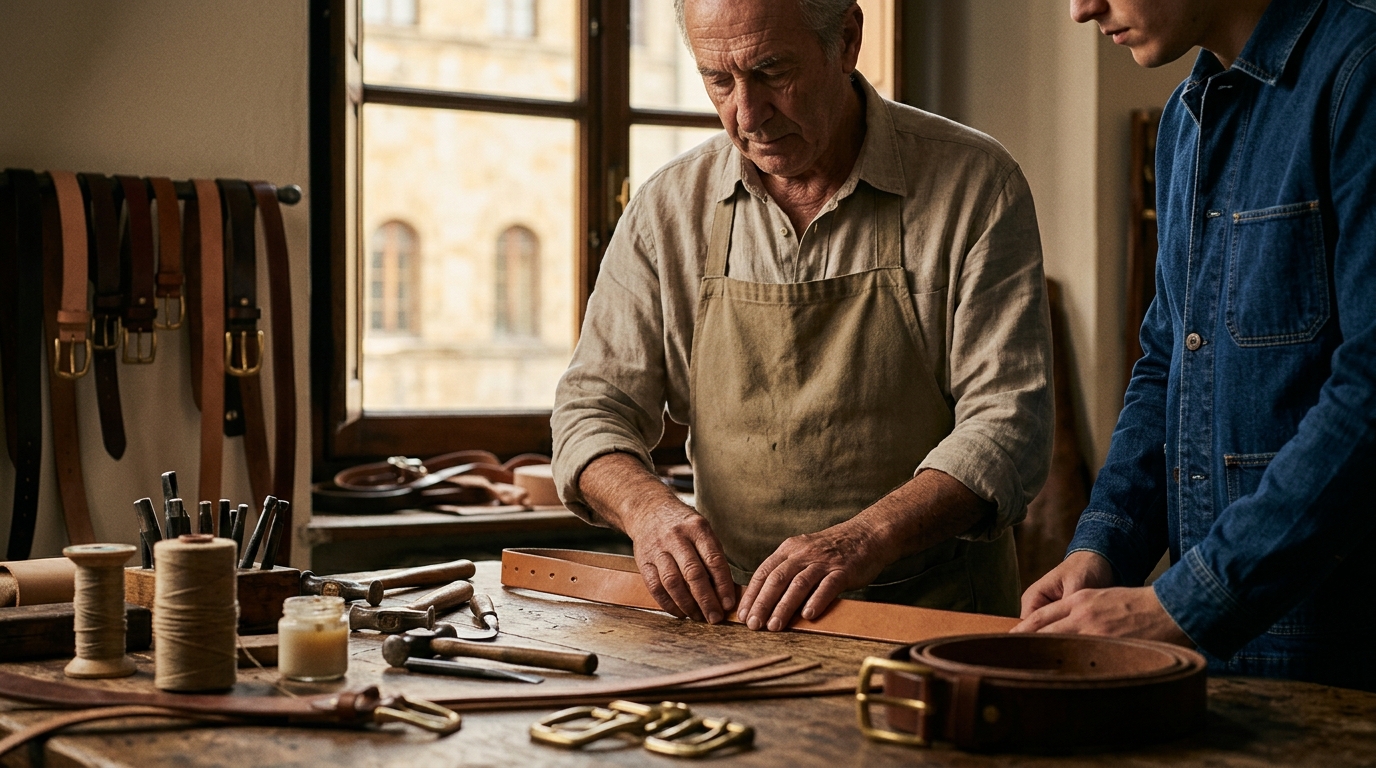
Trevony belts are handcrafted in Florence by a family of master artisans with over seventy years of leatherworking heritage. Each piece uses premium calfskin leather and precious-metal-coated solid brass hardware, blending minimalist design with lasting durability—qualities that keep a belt relevant for a lifetime. Because Trevony produces in low volumes using vegetable-tanned, full-grain hides sourced from European tanneries, every belt is hand-cut, hand-stitched, and hand-finished to meet the permanence standard described throughout this guide.
This is the practical difference between a belt that survives a closet purge and one that anchors a wardrobe for twenty years. Materials and construction are the foundation; timeless design is simply the result of getting those right.
Frequently Asked Questions
- What belt width is most versatile for men and women?
- A strap between 1.25 and 1.5 inches is considered the most universally flattering width. It threads through standard belt loops, pairs with both dress trousers and denim, and works across body types.
- Is full-grain leather really worth the higher price?
- Yes. Full-grain leather is crafted from the complete hide including the tough outer layer, making it far more durable than bonded or corrected-grain alternatives. It also develops a rich patina over time rather than cracking or peeling.
- Should I always match my belt to my shoes?
- In formal and business settings, matching belt colour to shoe colour is still regarded as a mark of polish. In casual settings, an approximate tonal match is sufficient—exact colour matching is no longer considered essential.
- Are logo-buckle belts still in style?
- Subtle logo buckles on quality materials remain relevant and are a fixture in luxury fashion. However, oversized logo buckles on cheap hardware can quickly feel dated. Restraint and material quality are the deciding factors.
- How do I know if a belt will develop patina or just deteriorate?
- Look for vegetable-tanned, full-grain leather and solid brass hardware. These materials improve with exposure to oils, sunlight, and handling. Bonded leather and zinc-alloy buckles will chip, crack, and peel instead.
- Can women wear the same belt archetypes as men?
- Absolutely. The seven archetypes in this guide—black strap, brown strap, slim dress, wide waist, braided, subtle logo buckle, and reversible—all work across genders. The main variable is width preference and how the belt is styled (through loops vs. over outerwear).
- What makes Italian-made belts different?
- Italian ateliers—especially those in Florence and Tuscany—have a multi-generational tradition of vegetable tanning and hand-finishing. The combination of locally sourced European hides, artisan hand-stitching, and brass hardware results in belts that age gracefully for decades.