
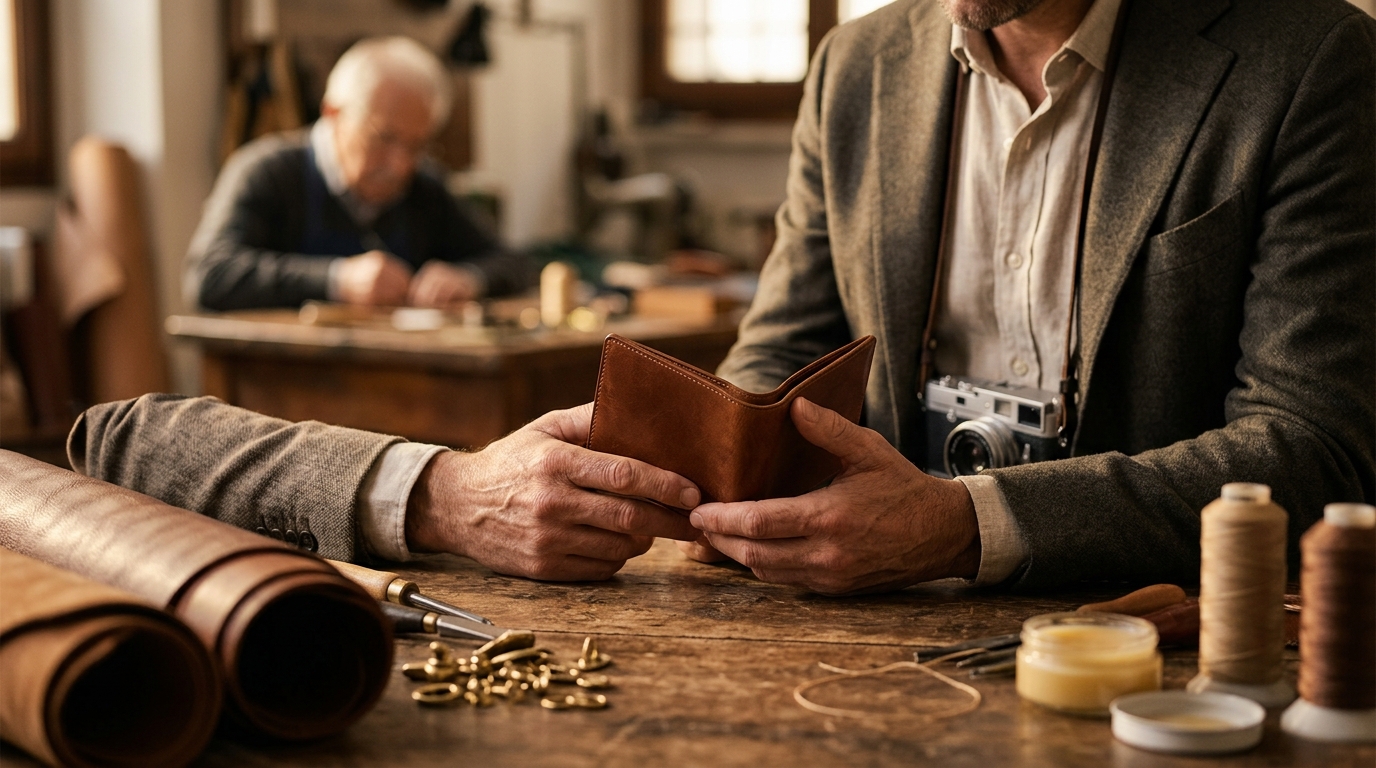
Your wallet is handled more than almost any other accessory you own—pulled from a pocket dozens of times a day, bent, sat on, and stuffed with cards. Yet most people spend more time choosing a phone case than the leather companion that will ride along for years. This tutorial gives you a concrete, seven-checkpoint system for evaluating any leather wallet before you buy, so the one you pick today still looks better five years from now.
Checkpoint 1 — Read the Hide Grade, Not the Price Tag
Before anything else, identify exactly what type of leather is in front of you. The leather industry recognizes several grades, and the terminology is deliberately confusing to consumers.
Full-Grain Leather — The Gold Standard
Full-grain leather retains the complete outer surface of the animal hide with none of it sanded or buffed away. This preserves the densest concentration of fibers, giving the material unmatched strength, breathability, and the ability to develop a rich patina with age. When experts rank hide quality, full-grain consistently sits at the top.
Top-Grain Leather — A Step Below
Top-grain leather has been lightly sanded to remove surface imperfections. The result is a thinner, more uniform material that is easier for manufacturers to work with and usually less expensive at retail. It is the most commonly used grade in high-end leather products, but it sacrifices some of the fiber density that makes full-grain so resilient.
Grades to Avoid
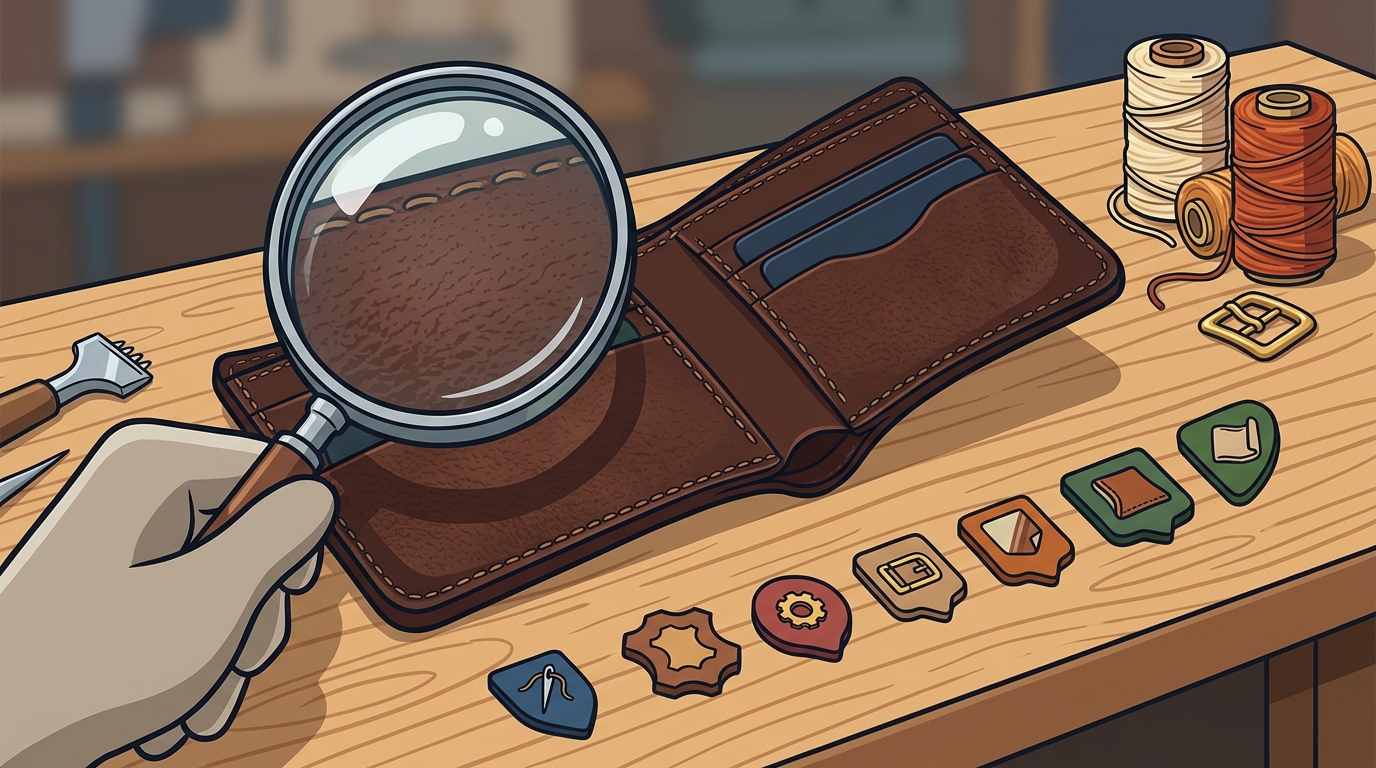
Two labels should raise immediate red flags. Genuine leather is a marketing term that sounds reassuring but actually designates one of the lowest acceptable grades—often consisting of split layers that have been heavily coated with polyurethane to mask defects. Bonded leather is even worse: scraps and leather dust fused together with adhesives. Neither develops patina, and both degrade quickly under daily use.
Trevony wallets are cut exclusively from full-grain, European-sourced hides so that every piece begins with the strongest possible foundation. When you see natural grain variations on a Trevony wallet, those are markers of authenticity and structural integrity—not flaws to hide.
Checkpoint 2 — Decode the Tanning Method
The tanning process determines how leather feels, ages, and impacts the environment. Two methods dominate the market, and understanding them will instantly sharpen your evaluation.
Vegetable Tanning
Vegetable tanning uses natural tannins extracted from tree bark, leaves, and other plant materials. The process can take up to two months per hide, is largely performed by hand, and uses no harsh industrial chemicals. The resulting leather is firmer when new but softens beautifully with use, developing a distinctive patina unique to its owner. It is the more sustainable method and has been practiced for centuries, particularly in Tuscany.
Chrome Tanning
Chrome tanning relies on chromium sulphate salts and can finish a hide in as little as a single day. It produces softer, more uniformly colored leather and accounts for roughly 80–90 percent of global leather production. However, chrome-tanned leather does not develop patina in the same way, and the process generates toxic wastewater containing chromium and other hazardous compounds—a significant environmental concern, especially in regions with lax regulation.
A Quick Transparency Test
Brands that use vegetable tanning almost always say so prominently because it is a strong differentiator. If a manufacturer says nothing about the tanning method, you can generally assume the leather is chrome-tanned. At Trevony, every wallet is made from vegetable-tanned hides processed by European tanneries, a commitment rooted in our partnership with a Florentine atelier that has worked leather the traditional way for over seventy years.
Checkpoint 3 — Inspect Stitching and Edge Work
Leather quality means nothing if the construction falls apart. Two details reveal more about a wallet's durability than almost anything else.
Stitching
Look for stitches that are even, tight, and free of loose threads. The spacing matters, too. Stitches placed too close together perforate the leather and create a tear line—like the perforated edge of a sheet of paper. Quality makers carefully calibrate stitch density to balance strength and material integrity.
Thread composition is equally important. Low-cost nylon thread is made from short fibers wound together; these fibers separate under friction, heat, and UV light, causing seams to unravel. Premium wallets use continuous-filament polyester or waxed linen thread engineered for decades of service.
Edge Finishing
Run your finger along the wallet's edges. A high-quality piece will have smooth, burnished, or painted edges with no rough spots or peeling. Mass-produced wallets often leave edges raw or apply a cheap sealant that cracks within months. Hand-finished edges—like those on every Trevony wallet—are sanded, dyed, and polished multiple times until they feel like glass.
Checkpoint 4 — Match the Format to Your Real Carry
The best leather in the world will not help you if the wallet does not suit your daily habits. Before buying, empty your current wallet and honestly assess what you actually carry.
| Format | Best For | Typical Capacity |
|---|---|---|
| Bifold | Back-pocket carry, cash and cards in equal measure | 6–8 card slots, bill compartment |
| Slim / Card Case | Front-pocket or jacket carry, card-dominant lifestyle | 4–6 cards, folded bills |
| Long Wallet | Bag carry, travel documents, unfolded bills | 10+ card slots, zip pocket, full-length bill section |
| Zip-Around | Maximum security, coin storage, all-in-one carry | 8–12 card slots, coin pocket, bill dividers |
Trevony offers each of these formats in full-grain vegetable-tanned leather, hand-cut in our Florence workshop. Whether you favor the minimal footprint of a slim card case or need the generous layout of a long wallet for international travel, the construction quality remains identical across every style.
Checkpoint 5 — Evaluate the Provenance and Maker
Where a wallet is made—and by whom—tells you as much as the materials list.
Questions to Ask
- Where are the hides sourced? European tanneries, particularly those in Italy's Tuscany region, are renowned for the highest standards in vegetable tanning. Look for certifications like the Consorzio Vera Pelle Italiana Conciata al Vegetale trademark—a handprint inside a hide silhouette that guarantees genuine Italian vegetable-tanned leather.
- Is the wallet hand-cut or die-cut? Hand-cutting allows an artisan to work around natural imperfections and position the grain optimally for each panel. Die-cutting is faster but indiscriminate.
- What is the production volume? Low-volume, atelier-based production typically correlates with tighter quality control and better finishing than high-volume factory output.
Trevony partners with a single family-run Florentine workshop where artisans hand-cut, hand-stitch, and hand-finish every wallet. This low-volume model means each piece receives individual attention from craftspeople whose families have refined these techniques across generations.
Checkpoint 6 — Perform the Sensory Test
If you can handle the wallet before purchasing—or even if you are evaluating it upon delivery—use your senses as quality instruments.
- Touch: High-quality full-grain leather feels substantial but not rigid. You should sense a slight texture from the natural grain—not a perfectly smooth, plastic-like surface. Vegetable-tanned leather will be firmer at first and soften over weeks of handling.
- Smell: Genuine premium leather has a rich, earthy aroma. A strong chemical or plastic odor signals artificial treatment or low-grade material.
- Sight: Look for subtle grain variations, slight color shifts, and the occasional natural mark. These are signatures of a full-grain, minimally processed hide—proof that no synthetic coating has been applied to create artificial uniformity.
Checkpoint 7 — Plan for Patina and Long-Term Care
A truly high-quality leather wallet is not a static object. It is designed to change—and the way it changes should make you like it more, not less.
What Patina Actually Is
Patina is the gradual darkening, softening, and deepening of color that occurs as vegetable-tanned leather interacts with the oils in your hands, ambient light, and everyday friction. It is unique to each owner and cannot be replicated artificially. Full-grain vegetable-tanned leather develops the most beautiful patina because its uncoated surface absorbs and responds to its environment.
Basic Care Routine
- Weekly: Wipe the exterior with a dry, soft cloth to remove surface dust.
- Monthly: Apply a thin layer of leather conditioner or balm made from natural waxes. Avoid products containing silicone or petroleum, which clog pores and block patina development.
- As needed: If the wallet gets wet, let it air-dry at room temperature away from direct heat. Once dry, apply conditioner to restore suppleness.
- Storage: When not in use for extended periods, keep the wallet in a breathable cloth pouch in a cool, dry location away from direct sunlight.
Every Trevony wallet ships with a care card outlining these steps, because we believe the after-purchase experience is as important as the moment of unboxing.
Key Takeaways
- Full-grain is non-negotiable for a wallet you want to carry daily for years. It is the strongest grade and the only one that develops genuine patina.
- Vegetable tanning outperforms chrome tanning for longevity, aging character, and environmental responsibility—though it costs more and feels firmer at first.
- Stitching density, thread quality, and edge finishing are the construction details that separate a five-year wallet from a fifty-year one.
- Match the wallet format to your actual carry habits, not to what looks good in a product photo.
- Provenance matters: know where the hides come from, how they are tanned, and who assembles the final product.
- Embrace patina: the best leather wallets are designed to get better, not worse, with daily use.
Frequently Asked Questions
What is the best leather for an everyday wallet?
Full-grain, vegetable-tanned leather is the best option for daily use. Full-grain retains the entire outer surface of the hide, giving it maximum fiber density and tear resistance. Vegetable tanning adds longevity and allows the leather to develop a rich, personalized patina over time. This combination delivers durability, beauty, and character that improve with every day of use.
How can I tell if a leather wallet is high quality?
Use a three-part sensory check. Touch it: real full-grain leather feels substantial with visible natural grain, not perfectly smooth or plastic-like. Smell it: quality leather has a rich, earthy aroma—never a chemical odor. Inspect it: look for even, tight stitching with no loose threads, smooth burnished edges, and subtle grain variations that indicate an uncoated, minimally processed hide.
What is the difference between vegetable-tanned and chrome-tanned leather wallets?
Vegetable tanning uses natural plant-based tannins and can take weeks or even months, producing a firmer leather that softens and develops patina with use. Chrome tanning uses chromium salts and finishes in about a day, yielding softer, more colorful leather that does not age with the same character. Vegetable tanning is more environmentally responsible, while chrome tanning dominates the market because it is faster and cheaper.
Why does "genuine leather" not mean high quality?
Despite the reassuring name, "genuine leather" is an industry classification that typically refers to one of the lowest acceptable grades. It is often made from split layers of the hide that have been coated with polyurethane to conceal defects. It lacks the fiber density of full-grain leather, does not develop patina, and tends to crack or peel within one to two years of regular use.
How should I care for a vegetable-tanned leather wallet?
Wipe it weekly with a dry soft cloth, condition it monthly with a balm based on natural waxes, and let it air-dry away from direct heat if it gets wet. Avoid silicone- or petroleum-based products, which clog the leather's pores and inhibit patina. Store it in a breathable cloth pouch when not in use for long periods.
Are Trevony wallets made in Italy?
Yes. Every Trevony wallet is handcrafted in Florence, Italy, by a family-run atelier with over seventy years of leatherworking heritage. The hides are full-grain and vegetable-tanned, sourced from European tanneries, and each wallet is hand-cut, hand-stitched, and hand-finished to ensure heirloom-quality construction.