
Published by Trevony Editorial
Five Questions to Ask Any Leather Goods Provider Before You Buy
Stop comparing logos. Start comparing answers. These five questions expose the real gap between marketing language and heirloom-worthy craftsmanship—so you invest in leather goods that actually last.
Why the Right Questions Beat Brand Recognition
The leather goods market is enormous—and terminology is unregulated. There is no universal grading standard enforced across retail; the terms you see on product pages are market language, not legal classifications. That information asymmetry means a shopper who relies solely on brand prestige or price tags will frequently overpay for inferior materials.
The solution is simple: ask better questions. A provider who can answer all five of the questions below with specifics—not vague marketing copy—deserves your consideration. One that deflects or generalizes is telling you something important.
Question 1 — "What Grade of Leather Do You Actually Use?"
This single question eliminates most pretenders. Leather is broadly classified into four tiers, and the differences in durability and aging are dramatic.
Full-Grain Leather
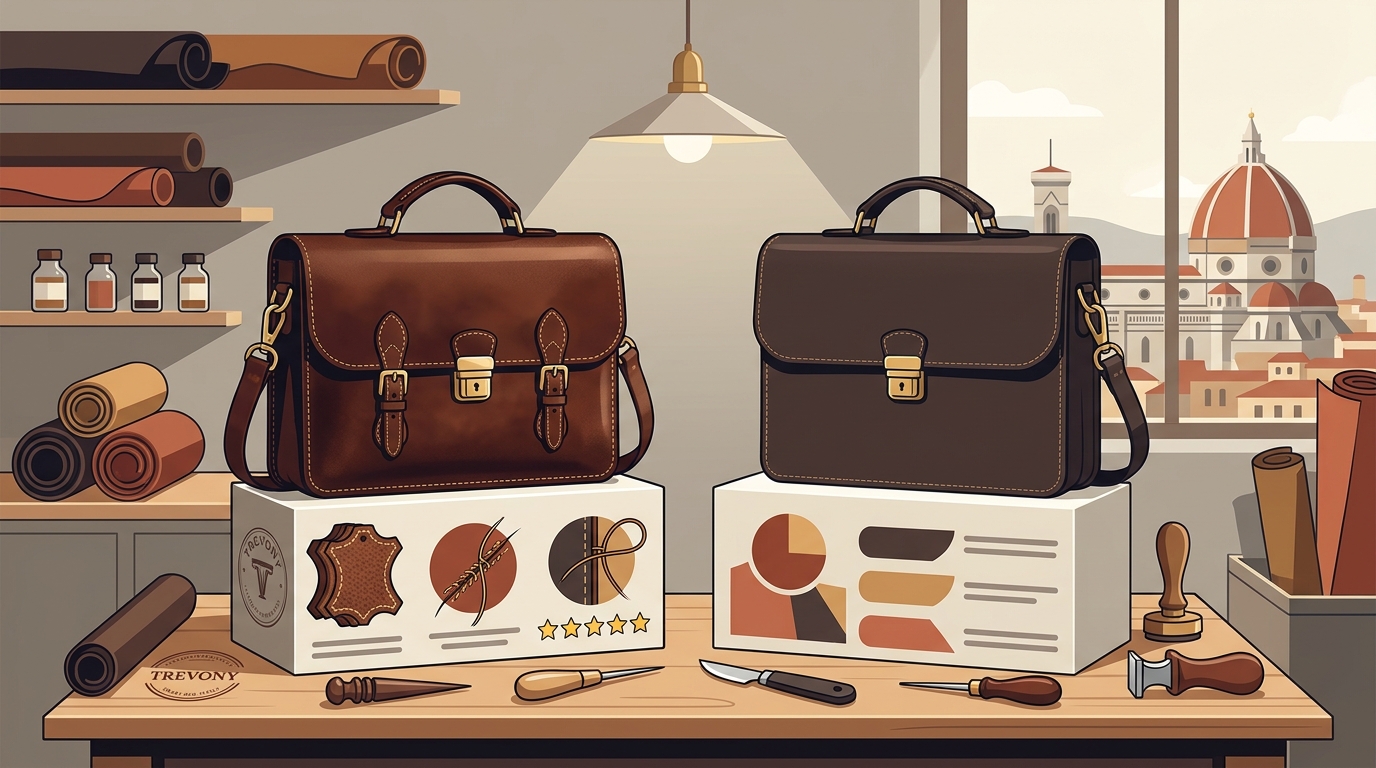
Full-grain leather is the highest quality you can find. It comes from the outermost layer of the hide and retains all its natural grain, including minor scars and wrinkles that add character. Rather than wearing out, full-grain leather develops a rich patina over time—a soft sheen that deepens with age and use. With regular conditioning, full-grain leather can last 20 to 30 years or more and typically looks better than new after a decade of use.
Top-Grain Leather
Top-grain leather is the second-highest grade. Its surface is lightly sanded to remove imperfections, producing a smoother, more uniform appearance. It is slightly less durable than full-grain but still long-lasting, typically 10 to 20 years with regular care. It offers better stain resistance, making it popular for fashion-forward designs that need to look pristine.
Genuine Leather — The Misleading Label
Despite its reassuring name, \"genuine leather\" is actually a catch-all term that simply means the product is technically not plastic. It is often made from lower split layers of the hide, coated with polyurethane to mimic the look of higher grades. Products labeled only \"genuine leather\" typically show significant wear within two to five years and cannot develop a meaningful patina. If a product only says \"genuine leather,\" it is not necessarily high quality.
Bonded Leather
Bonded leather is the lowest grade, made from leather scraps and fibers bonded with adhesives. It is the least durable option and is prone to peeling and cracking, often within months of regular use.
What to listen for
A trustworthy provider will specify the exact grade—and ideally the part of the hide used. If the seller hesitates or can't provide clear answers, that's a red flag. Look for language like \"full-grain, vegetable-tanned calf\" rather than just \"premium leather\" or \"real leather.\"
Question 2 — "How Is the Leather Tanned, and Where Does the Hide Come From?"
The tanning method has a direct impact on how leather ages, feels, and smells over its lifetime.
Vegetable Tanning
Vegetable tanning is a traditional, environmentally friendlier method that uses natural tannins from tree bark. The process can take weeks or even months, but it results in leather that ages beautifully and develops a unique patina. Vegetable-tanned leather is more expensive but also more durable and develops richer character over time. Premium full-grain hides from Italian or American tanneries cost roughly $10–$25 per square foot at the raw material level.
Chrome Tanning
Chrome tanning is a faster, cheaper method that produces softer, more uniformly colored leather. While it is perfectly acceptable for many applications, chrome-tanned leather doesn't develop the same depth of patina, and the process carries greater environmental concerns if not managed responsibly.
Origin matters
Italian leather often carries a premium due to the country's centuries-long heritage of craftsmanship. European tanneries generally adhere to stricter environmental regulations and quality controls than facilities in regions where oversight is less rigorous. Ask whether the provider can name the tannery or at least the country of origin for their hides.
Question 3 — "Can You Walk Me Through Your Construction Details?"
Material quality means little if the bag is poorly assembled. Construction is where true artisan brands distinguish themselves from mass-market producers.
Stitching
Hand-stitching with linen or waxed thread creates a saddle stitch that will not unravel even if one thread breaks. Machine lockstitch, by contrast, can cascade apart from a single broken point. Ask whether stitching is done by hand or machine, and what thread material is used.
Edge Finishing
Poor edge work often indicates mass production with cheaper materials. Quality leather goods feature burnished, painted, or folded edges that are smooth to the touch. Inspect edges closely—if they feel rough, look frayed, or show delamination, the construction is subpar.
Hardware
Brass, stainless steel, or solid metal hardware outlasts plated zinc alloy by years. Ask what the hardware is made from—and whether zippers carry a brand name like YKK or Riri.
Lining and Internal Structure
A quality bag uses cotton twill, suede, or microfiber lining rather than cheap polyester. Internal reinforcement panels—sometimes leather, sometimes canvas—prevent the bag from losing its shape over years of use.
Question 4 — "How Does Your Price Reflect Long-Term Value?"
Sticker price is a poor proxy for value. The metric that actually matters is cost-per-year of ownership.
The Price-Tier Reality Check
In the $300 to $600 range, you should expect full-grain leather from direct-to-consumer brands or quality top-grain from established names, along with construction that includes brass hardware and reinforced stitching. Between $600 and $1,000, expect full-grain leather with vegetable-tanned options, hand-finished edges, and quality linings. Above $1,000 for non-exotic leather, you are increasingly paying for brand positioning—heritage storytelling, flagship retail presence, and celebrity endorsements—rather than proportional quality improvements.
Cost-Per-Year Math
A full-grain leather bag that costs $600 and lasts 20 years works out to $30 per year. A $150 genuine-leather bag that wears out in three years costs $50 per year—and you experience the inconvenience and waste of repeat purchases. When you calculate cost per wear, the durable, higher-quality item is almost always the more economical choice. A full-grain leather belt at $150–$300 that lasts 10–15 years equates to $10–$20 per year, while a budget genuine-leather belt at $20–$40 replaced every 2–3 years costs the same annual amount but delivers a vastly inferior experience.
What to watch for
Be wary of brands that cannot explain what their price covers. A transparent provider breaks down the value chain: materials, labor, overhead, and margin. The craftsmanship alone—cutting, stitching, and finishing by skilled artisans—can add 30–50% to a product's base cost, which is a sign of quality, not inflation.
Question 5 — "Where Can I Read Unfiltered Customer Reviews?"
Reviews are the final validation layer, but not all review sources are equal.
Where to Look
- Independent platforms: Trustpilot, Google Reviews, and Reddit threads are harder for brands to manipulate than on-site testimonials.
- Long-term updates: Seek out reviews that include photos after 6, 12, or 24 months of use. Leather that looks great on arrival but peels within a year will be exposed in follow-up posts.
- Specific praise vs. vague superlatives: \"The burnished edges still look crisp after eight months of daily carry\" is more informative than \"Great bag, love it!\"
Red Flags in Reviews
- Clusters of five-star reviews posted on the same day with nearly identical phrasing.
- No reviews mentioning patina development, leather smell, or aging—this often means the product is too new or too short-lived for anyone to report on long-term performance.
- A brand that deletes or hides negative feedback rather than responding constructively.
Green Flags in Reviews
- Repeat customers who mention buying a second or third item from the same brand.
- Detailed descriptions of how the leather has changed over time—darkening, softening, developing sheen.
- Customer service stories showing the brand stands behind its product with repairs or replacements.
Putting It Together: The Five-Answer Comparison Matrix
Before you commit to any leather goods provider, record their answers in a simple comparison table. Here is a template you can copy:
| Question | Brand A | Brand B | Brand C |
|---|---|---|---|
| 1. Leather grade | |||
| 2. Tanning method & hide origin | |||
| 3. Construction details | |||
| 4. Price justification & cost-per-year | |||
| 5. Independent review sources |
The provider who gives you the most specific, verifiable answers across all five rows is almost always the safest choice—regardless of how recognizable their logo is.
How Trevony Answers All Five
We built Trevony around the belief that a luxury leather piece should answer every hard question before a customer needs to ask. Here is how we respond:
- Leather grade: Every Trevony bag and accessory is crafted from full-grain, vegetable-tanned leather sourced from European tanneries. We never use corrected-grain, bonded, or split leather.
- Tanning and origin: Our hides are vegetable-tanned using traditional methods—a process that takes weeks, not hours—at established European tanneries. The result is leather that develops a rich, individualized patina with daily use.
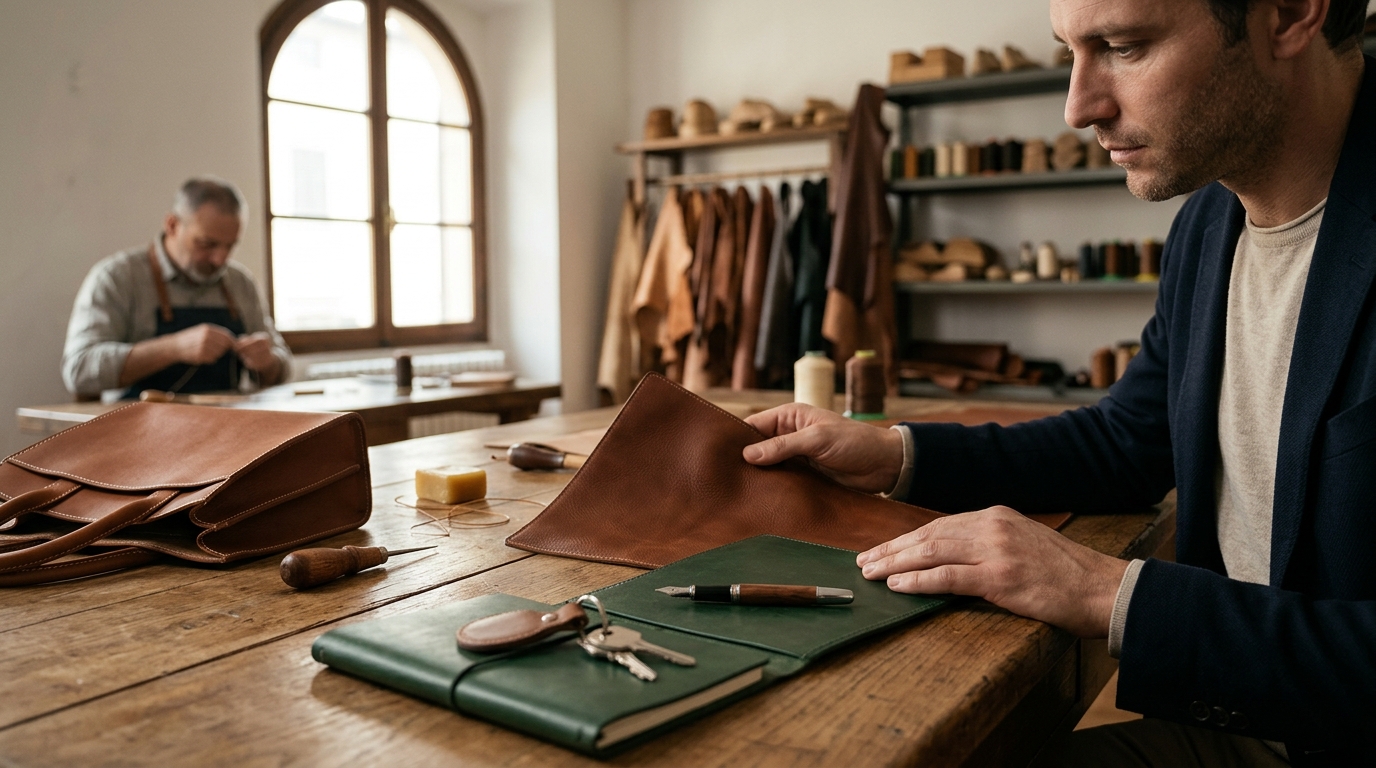
- Construction: Each piece is hand-cut, hand-stitched, and hand-finished in a family-run Florentine atelier that has worked leather for over seventy years. We use brass and solid metal hardware, burnished edges, and cotton or suede linings.
- Price and value: Trevony operates a low-volume, direct-to-consumer model. You pay for materials and artisan labor—not for billboard campaigns or department-store markups. Our bags are designed for decades of daily use, making the cost-per-year exceptionally low for the quality tier.
- Reviews: We encourage customers to share unfiltered feedback—including long-term patina photos—on independent platforms and our own site, because transparency is the foundation of trust.
Key Takeaways
- Ask for the leather grade by name. Full-grain is the gold standard; \"genuine leather\" is often the lowest tier of real leather.
- Demand tanning and origin details. Vegetable tanning produces leather that ages beautifully; knowing the tannery or country of origin signals transparency.
- Inspect construction, not just materials. Hand-stitching, burnished edges, and solid hardware separate heirloom pieces from disposable fashion.
- Calculate cost-per-year, not sticker price. A $600 bag lasting 20 years costs less per year than a $150 bag replaced every three years.
- Read long-term, independent reviews. Look for patina photos, repeat buyers, and constructive brand responses to complaints.
Frequently Asked Questions
How can I tell if a leather bag is full-grain just by looking at it?
Look for natural surface variations—irregular pores, subtle wrinkles, and minor healed scars. A perfectly uniform, flawless surface with a repeating pattern usually indicates heavy processing or an artificial grain. Also examine the cut edges: full-grain leather shows a consistent, dense fibrous texture with no visible layering or plastic-looking core.
Is vegetable-tanned leather better than chrome-tanned leather?
For patina lovers, yes. Vegetable tanning is a slower, traditional method that produces leather which ages beautifully and develops unique character over years of use. Chrome tanning is faster and yields softer, more uniformly colored leather, but it generally does not develop the same depth of patina. Neither is objectively \"better\"—it depends on whether you prioritize aging character or uniform softness.
What is a fair price for a quality leather handbag?
In the $300–$600 range, you can find full-grain leather bags from direct-to-consumer brands with brass hardware and reinforced stitching. Between $600 and $1,000, expect vegetable-tanned options with hand-finished edges. Above $1,000 for non-exotic leather, you are often paying more for brand prestige than for proportional quality gains.
How long should a good leather bag last?
A full-grain leather bag with regular conditioning can last 20 to 30 years or more. Top-grain leather typically lasts 10 to 20 years. Genuine leather products usually show significant wear within two to five years of daily use and cannot be meaningfully restored through conditioning.
What should I look for in customer reviews of leather goods?
Prioritize reviews that include photos after months of use, mention specific details like patina development or edge durability, and come from independent platforms like Trustpilot or Google Reviews. Be skeptical of clusters of five-star reviews posted on the same day with nearly identical language.
Why does Italian leather cost more?
Italian leather carries a premium due to the country's centuries-long heritage of craftsmanship, stricter European environmental regulations, and the prevalence of traditional vegetable-tanning methods that take weeks rather than hours. The combination of superior raw materials, skilled artisan labor, and rigorous quality control justifies the higher price.