
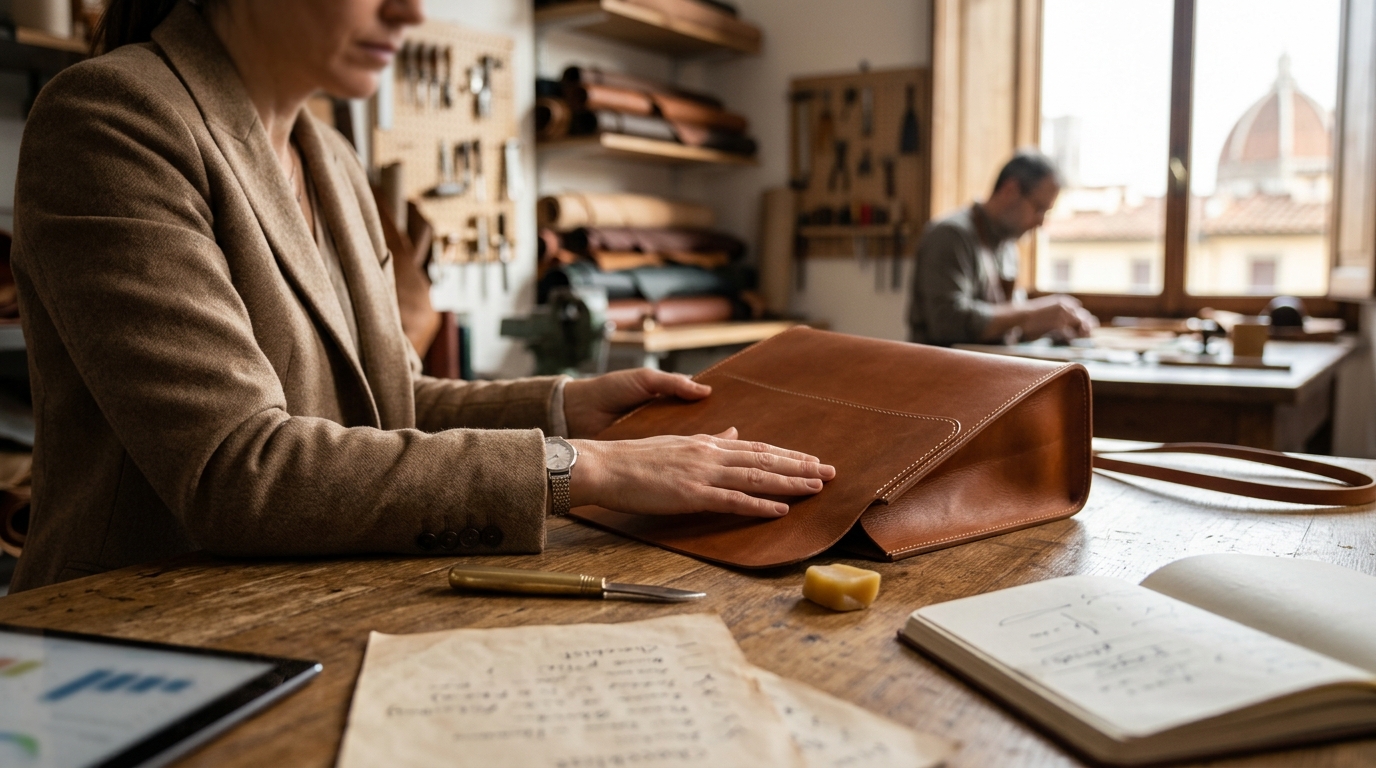
Buying leather goods can feel overwhelming. Hundreds of brands promise 'premium quality,' but the gap between marketing language and actual craftsmanship is wider than ever. This step-by-step checklist will walk you through every checkpoint—material grade, construction details, pricing transparency, and customer feedback—so you can confidently separate heirloom-worthy pieces from disposable fashion.
Step 1 — Decode the Leather Grade
Not all leather is equal, and labels can mislead. Leather is generally categorised into four grades: full-grain, top-grain, genuine, and bonded. Full-grain leather uses the outermost layer of the hide, retaining the natural grain pattern, tiny imperfections, and the densest fibre structure. It is the strongest and most durable cut available. Over time it develops a patina—a thin protective layer that also gives the surface a richer, more personal character.
Top-grain leather is sanded to remove imperfections and coated with an artificial finish. It is still a good material, but it is less breathable and develops patina more slowly. 'Genuine leather' is a legally permissible but misleading term—a manufacturer can call a product genuine leather as long as it contains some form of animal hide, regardless of quality. Always look specifically for 'full-grain' on the label to guarantee the top tier.
What to do
- Ask the brand explicitly: Is this full-grain leather? If the answer is vague or redirected, treat it as a red flag.
- Look at the surface up close. Natural imperfections—tiny scars, faint stretch marks—are signs of authentic full-grain hide, not defects.
- Press your thumb into the leather. Genuine full-grain will show a temporary colour shift and bounce back.
Step 2 — Investigate the Tanning Method
Tanning is the preservation process that turns raw hide into usable leather, and it profoundly affects longevity, feel, and environmental impact. The two primary methods are vegetable tanning and chrome tanning.
Vegetable tanning relies on natural plant-based tannins—tree bark extracts like quebracho and wattle—and takes weeks or even months to complete. The resulting leather is firmer at first but softens beautifully with use, develops a dramatic patina, and carries a distinctive earthy, slightly sweet aroma. Chrome tanning uses chemical salts and can be finished in hours. It produces softer, more water-resistant leather at a lower cost, but the material ages less gracefully and carries a higher environmental footprint.
For everyday items you plan to keep for years—wallets, belts, handbags—vegetable-tanned full-grain leather offers the best long-term value. A well-cared-for piece made this way can last 20-plus years, becoming more attractive rather than wearing out.
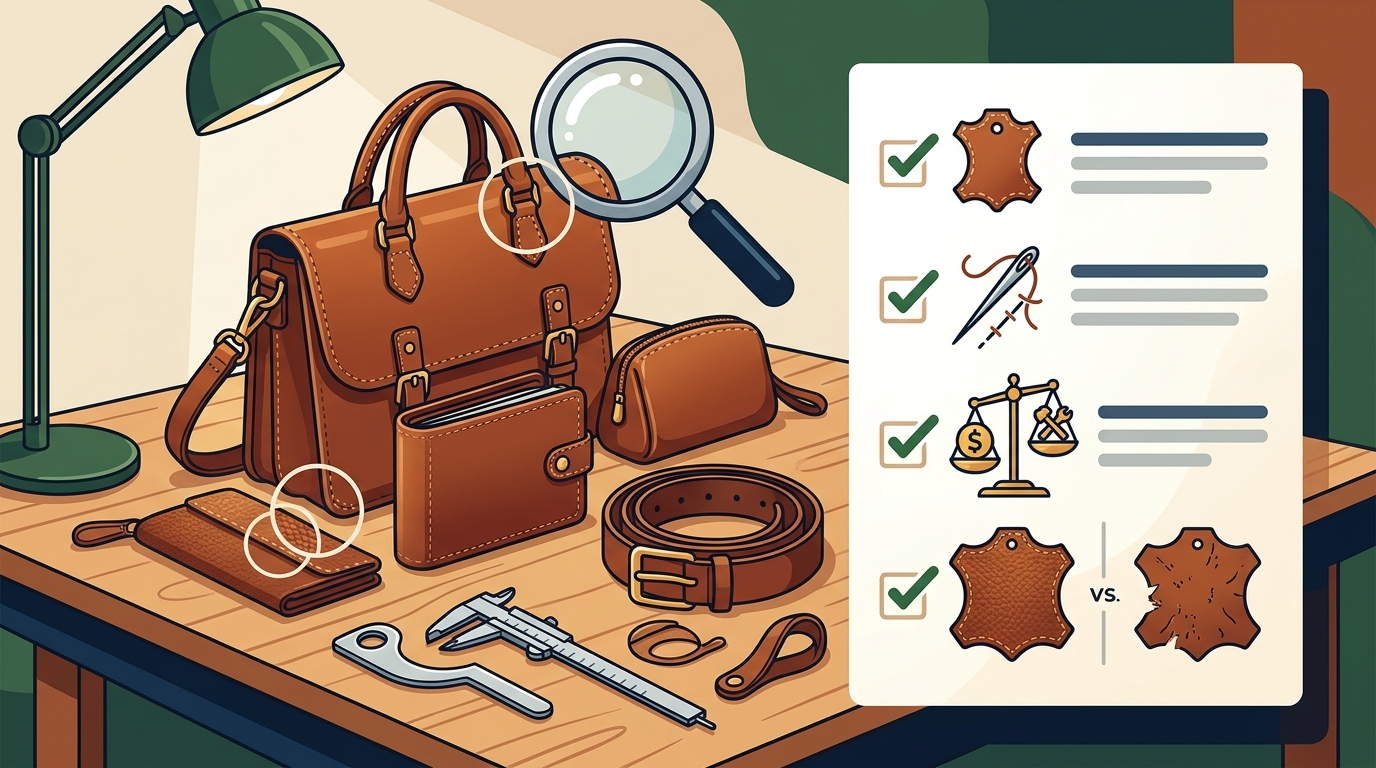
What to do
- Check whether the brand discloses the tanning method. Reputable artisan producers—like those in Florence's historic leather district—will name their tanneries or at least specify 'vegetable-tanned.'
- Smell the leather if you can. A warm, woody scent signals plant-based tanning; a chemical or plasticky odour points to chrome processes or synthetics.
Step 3 — Inspect Construction and Finishing
Material quality only matters if the construction matches. Here are the details that separate artisan work from factory shortcuts:
Stitching
High-quality leather goods typically feature 18–20 stitches per inch, applied with consistent tension. Lower stitch counts (10–12 per inch) suggest rapid machine assembly with less durability. Hand-stitching, as practised by traditional Italian ateliers, uses a saddle stitch where two needles pass through the same hole in opposite directions—so if one stitch breaks, the rest hold.
Edge finishing
Turn a bag or wallet over and examine the edges. Premium pieces will have hand-burnished edges that are smooth and glossy with no raw fibres showing. Some brands paint edges to conceal poor finishing—run a thumbnail along the edge to check whether the coating is superficial.
Hardware
Zippers, clasps, and buckles should feel heavy and operate smoothly. Lightweight or plasticky hardware is the first thing to fail, no matter how good the leather is.
Lining and interior
A quality provider lines bags with durable fabric (cotton twill, microsuede, or matching leather), not thin polyester. Interior pockets should have reinforced stitching at stress points.
What to do
- Run your thumbnail along every edge you can reach.
- Open and close zippers at least five times—listen for smooth movement.
- Check the underside or interior of the leather. A rough, fibrous backing is natural and expected; a fabric or plastic mesh backing is synthetic.
Step 4 — Assess Pricing Honestly
Price is the most misunderstood criterion. Many shoppers assume that an expensive bag automatically equals superior quality, or that a lower price always signals inferior materials. Neither is reliably true in today's market.
Why big-name luxury can disappoint
Many large luxury houses have shifted toward mass production, bigger marketing budgets, and trend-driven collections, with craftsmanship taking a back seat to profit margin and brand recognition. Industry insiders report that consumers increasingly pay a premium for the brand name itself, rather than for superior materials and workmanship.
The direct-to-consumer advantage
Smaller, artisan-focused brands that sell directly to customers avoid the wholesale and retail markups that inflate traditional luxury pricing. This model allows them to invest more in materials and craftsmanship at the same or lower price point. For a well-made, full-grain leather handbag, a realistic range is roughly $150–$600 depending on size and complexity—substantially less than four-figure designer equivalents made from comparable or even inferior hides.
The cost-per-year calculation
Instead of comparing sticker prices, divide the purchase price by the number of years you expect to use the item. A $400 vegetable-tanned bag carried daily for 15 years costs about $27 per year. A $150 bonded-leather bag that cracks after two years costs $75 per year—nearly triple.
What to do
- Ask the brand what percentage of the price goes to materials and labour versus marketing and retail margin. Transparent companies answer this willingly.
- Calculate cost-per-year, not just sticker price.
- Be suspicious of prices that seem too good or too high relative to what's disclosed about materials.
Step 5 — Read Reviews Like a Detective
Customer reviews are invaluable, but only if you know how to read them critically. Here is a framework for extracting real signal from online feedback:
Filter for time-tested opinions
A five-star review written on delivery day tells you about packaging, not durability. Seek out reviews from buyers who have owned the product for six months or more. Look for phrases like 'still looks great after a year' or descriptions of how the leather has aged.
Pay attention to recurring specifics
One complaint about a zipper could be an outlier. Ten complaints about the same zipper across different product pages indicate a systemic quality issue. Similarly, repeated praise for patina development or hand-feel carries more weight than generic 'love it!' comments.
Cross-reference platforms
Don't rely on reviews hosted solely on the brand's own website. Check independent sources: Trustpilot, Google Reviews, Reddit leather-goods communities, and YouTube dissection channels where reviewers physically open and examine products.
Watch for review manipulation
Be wary of brands where every review is five stars with identical phrasing, or where negative reviews disappear. Authentic brands allow critical feedback to stand and respond constructively.
What to do
- Search for '[brand name] + review + 1 year later' to find long-term impressions.
- Look at photo reviews—they reveal real-world wear patterns, patina, and any premature damage.
- Check how the brand responds to complaints. A company that offers repair services or stands behind a warranty is investing in the product's longevity, not just the sale.
Step 6 — Verify Provenance and Transparency
Where a leather product is made and who made it are not just marketing details—they are quality indicators. A product stamped 'Made in Italy' from a family-run Florentine atelier, for example, reflects a regulatory environment, a supply chain of European tanneries, and decades of generational craftsmanship that are difficult to replicate at scale.
Questions to ask any provider
- Where are your hides sourced? European tanneries (Italy, France, Germany, Spain) are generally held to stricter environmental and quality standards.
- Who manufactures the goods? A brand that names its atelier, shares workshop photos, or describes its artisans' experience is far more credible than one that ships from an undisclosed factory.
- What is your production volume? Low-volume artisan production allows for hand-cutting, hand-stitching, and individual quality checks that high-volume lines cannot replicate.
- Do you offer repair or reconditioning services? Brands confident in their work stand behind it for the long term.
At Trevony, we answer every one of these questions openly. Our bags and accessories are handcrafted in a family-run Florentine atelier that has worked leather for over seventy years. We use full-grain, vegetable-tanned hides sourced from European tanneries, and every piece is hand-cut, hand-stitched, and hand-finished. This is not marketing language—it is our production process, and we invite you to ask about it.
Quick-Reference Checklist
| Checkpoint | Green Flag | Red Flag |
|---|---|---|
| Leather grade | Full-grain, natural imperfections visible | Labelled only 'genuine leather' or 'real leather' |
| Tanning method | Vegetable-tanned, earthy scent | Undisclosed method, chemical smell |
| Stitching | 18–20 SPI, consistent tension, saddle stitch | Loose threads, uneven spacing, low stitch count |
| Edges | Burnished, smooth, no raw fibres | Painted-over rough edges, peeling coating |
| Hardware | Solid, weighty, smooth operation | Lightweight, plasticky, sticky zippers |
| Pricing transparency | Brand explains cost breakdown | Extreme markup with no material disclosure |
| Reviews | Long-term reviews, photo evidence, mixed ratings | All 5-star, generic wording, no critical feedback |
| Provenance | Named atelier, disclosed tannery, 'Made in' label | No origin info, evasive about manufacturing |
Key Takeaways
- Grade matters most: Full-grain, vegetable-tanned leather is the gold standard for products meant to last decades.
- Construction reveals intent: Hand-stitching, burnished edges, and quality hardware signal a maker who prioritises longevity over speed.
- Price alone is unreliable: Some heritage luxury brands deliver less craftsmanship per dollar than smaller artisan producers selling direct to consumer.
- Reviews need context: Filter for long-term ownership feedback, recurring specifics, and independent platforms.
- Transparency is non-negotiable: A trustworthy provider will name its tanneries, describe its process, and stand behind the product with repair services.
Frequently Asked Questions
- What is the single most important quality indicator when buying leather goods?
- The leather grade. Full-grain leather retains the hide's complete natural surface, giving it unmatched durability and the ability to develop a beautiful patina with age. It is denser, stronger, and more breathable than top-grain, genuine, or bonded alternatives.
- Is vegetable-tanned leather worth the extra cost?
- Yes, for items you use daily. Vegetable tanning takes 30 to 60 times longer than chrome tanning and uses natural plant tannins, which is why it costs more. However, the resulting leather lasts over 20 years with proper care and becomes more attractive over time—making the cost-per-year significantly lower than cheaper alternatives that crack and peel.
- How can I tell if online reviews for a leather brand are trustworthy?
- Look for reviews that describe the product after months of use, include photos of real-world wear, and appear on independent platforms like Trustpilot, Google, or Reddit—not only the brand's own site. Consistent specific praise or complaints across multiple platforms is the most reliable signal.
- Does 'Made in Italy' actually guarantee quality?
- 'Made in Italy' alone does not guarantee quality, but it indicates the product was manufactured under Italian regulations that govern production standards. When combined with a named atelier, disclosed European tanneries, and evidence of artisan hand-finishing, it is a strong positive signal. Ask the brand to describe its workshop and supply chain.
- Why do some $300 bags outperform $3,000 designer bags?
- Many large luxury brands allocate a significant share of pricing to marketing, retail overhead, and brand equity rather than materials and craftsmanship. Smaller direct-to-consumer brands can invest proportionally more in full-grain hides and skilled artisan labour because they avoid those markups. The result can be superior construction at a fraction of the price.
- How do I evaluate leather quality when shopping online?
- Check for detailed material disclosures (leather grade, tanning method, tannery name), close-up product photography showing grain texture and edge finishing, and long-term customer reviews with photos. Also look for a clear returns policy so you can inspect the item in person before committing.