
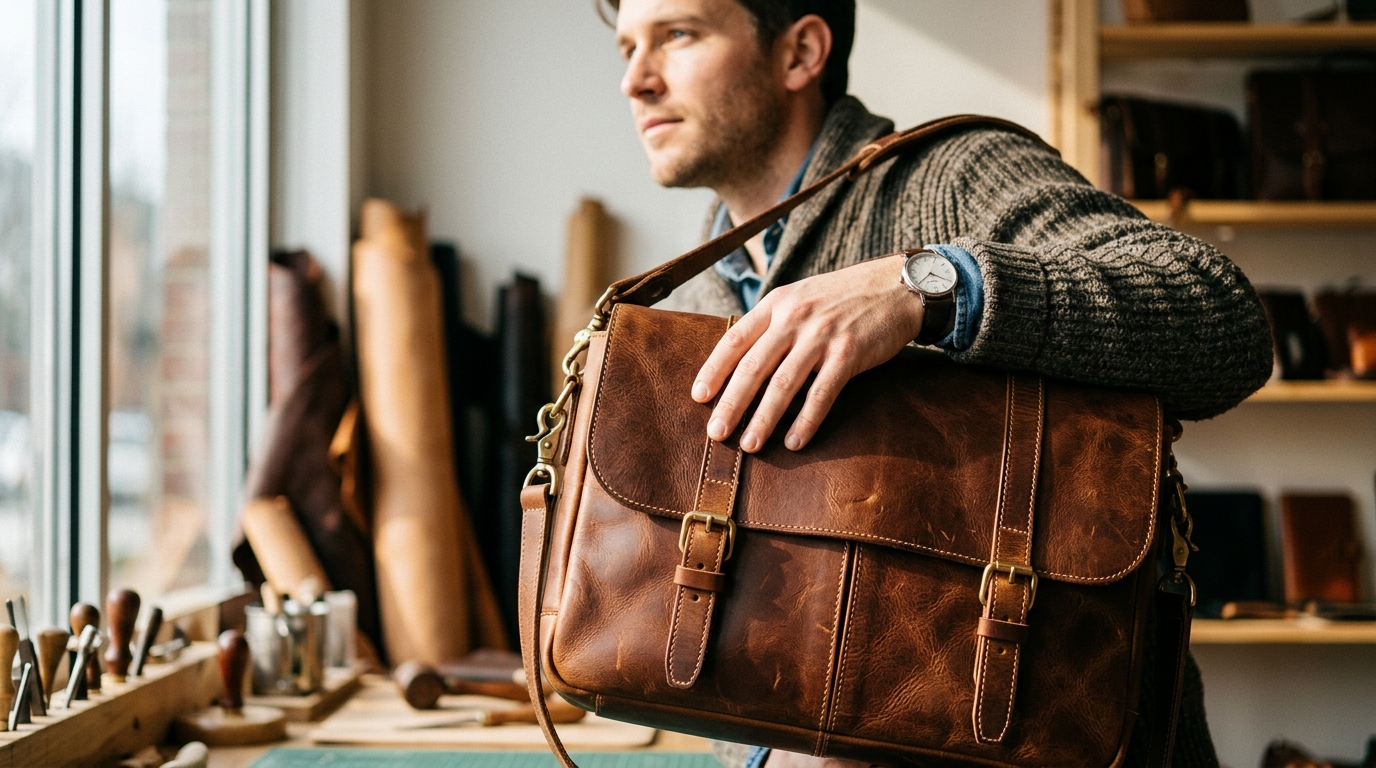
Full-grain leather sits at the very top of the leather hierarchy — prized by craftspeople, collectors, and discerning shoppers alike. But with synthetic alternatives growing more convincing each year, how do you know you are actually looking at the real thing? This ultimate guide breaks down every sensory cue, practical test, and structural detail that separates genuine full-grain leather from inferior grades and outright fakes.
What Makes Leather “Full-Grain”?
Full-grain leather is produced from the outermost layer of an animal hide — typically bovine — without sanding, buffing, or snuffing the surface. Because the grain is left completely intact, the hide retains its original pore structure, natural fibre density, and inherent toughness. This is what separates it from top-grain leather, where the surface is lightly sanded to remove imperfections, and from corrected-grain or bonded leather, which undergo heavy processing.
At Trevony, we select full-grain hides precisely because this untouched surface delivers unmatched longevity and a beauty that deepens with time. Understanding the signs below will help you confirm that any leather product you consider truly earns the “full-grain” label.
Visual Signs of Authenticity
1. Irregular, Organic Grain Pattern
Authentic full-grain leather displays a grain that varies in depth, direction, and pore spacing across the hide. No two square inches look identical. If the surface pattern repeats with machine-like precision, you are likely looking at an embossed or corrected-grain product. Hold the piece under natural light and study the texture — genuine full-grain will reveal a rich, organic complexity.
2. Visible Natural Pores
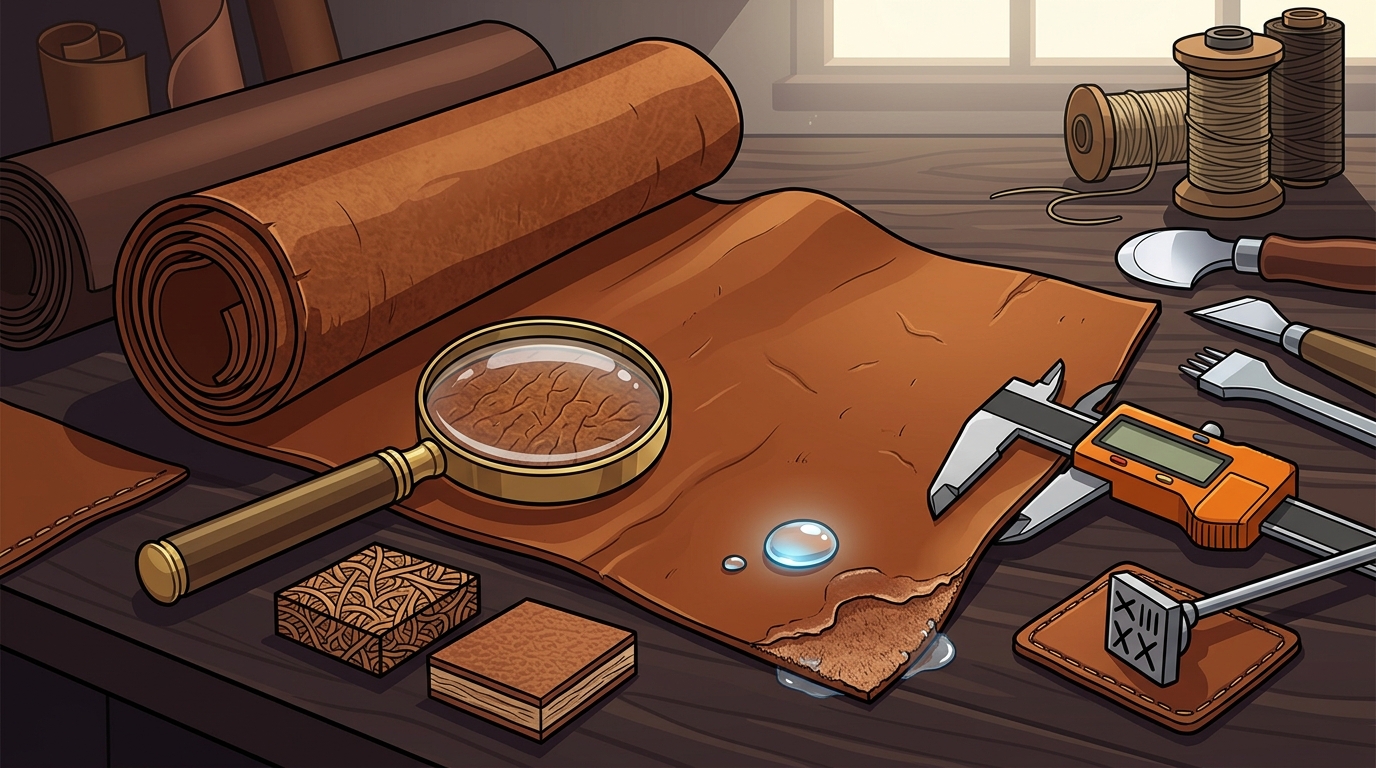
Every animal hide has pores, and in full-grain leather they remain fully visible. Bovine hides tend to show slightly larger, unevenly spaced pores, while calf leather presents a tighter, finer pattern. The key indicator is irregularity — overly uniform pore distribution is a red flag for artificial embossing.
3. Natural Imperfections
Scars from fence rubs, faint insect-bite marks, healed scratches, and subtle wrinkle lines are hallmarks of authentic full-grain leather, not defects to avoid. These marks confirm that the hide’s surface has never been sanded or corrected. Many leather aficionados actively seek out hides with pronounced character markings because they guarantee an unaltered grain.
4. Fat Wrinkles & Growth Lines
Fat wrinkles appear as subtle parallel lines on areas of the hide that once covered fatty deposits on the animal. They sometimes differ slightly in colour or texture because those zones absorb tanning agents differently. These are virtually impossible to replicate synthetically and serve as a reliable authentication marker.
5. Natural, Understated Lustre
High-quality full-grain leather reflects light softly, producing a warm, understated sheen rather than a glossy, plastic-like shine. If a hide looks overly polished or uniformly reflective, it has likely been coated with synthetic finishes to mask a lower-grade surface.
The Touch Test: What Your Fingers Should Tell You
- Suppleness with resilience: Press your thumb into the surface. Genuine full-grain leather will yield slightly, wrinkle naturally like skin, and spring back when you release. Faux leather resists compression and feels static.
- Warmth: Real leather absorbs your body heat within seconds, feeling warm to the touch. Synthetic alternatives stay cool and plasticky.
- Directional grain: Run your fingers across the surface in different directions. Full-grain leather often feels subtly rougher in one direction because of its natural fibre orientation.
- Natural waxy feel: The hide’s residual oils give full-grain leather a distinctive, slightly waxy surface that is completely different from the slick coating on synthetic or corrected-grain products.
The Smell Test
Arguably the fastest authenticity check: full-grain leather emits a warm, earthy aroma derived from the hide’s natural oils and the tanning agents used during processing. Vegetable-tanned full-grain leather often carries subtle woody or oaky notes. If you detect chemical, plasticky, or glue-like odours, the material is either synthetic or heavily processed lower-grade leather.
Practical At-Home Tests
Water Drop Test
Place a single drop of water on the surface. Full-grain leather is naturally porous, so the water will slowly absorb into the hide within a few seconds. On faux leather or heavily coated surfaces, water beads up and rolls off.
Bend Test
Gently bend the leather. Authentic full-grain will curve easily, create natural creases, and often shift slightly in colour at the fold — a phenomenon caused by internal oils migrating under tension. Faux leather remains uniformly coloured and resists bending.
Scratch Test
Lightly draw a fingernail across the surface. Full-grain leather may show a faint, temporary mark that blends back as the fibres resettle. Synthetic materials either show no mark at all or sustain permanent, flaking damage.
Patina: The Living Proof of Quality
One of the most celebrated attributes of full-grain leather is patina — the gradual deepening and enrichment of colour that occurs as the surface oxidises and absorbs natural oils from handling and the environment. A well-developed patina is impossible to fake; it proves the leather is real, full-grain, and has been allowed to age as nature intended. At Trevony, we consider patina development a feature, not a flaw — every bag we craft is designed to grow more beautiful with the years.
Edge & Stitching Inspection
Raw Edges
Examine the cut edges of the leather. Authentic full-grain hides will show rough, fibrous edges with visible layers of natural fibre. Synthetic leather has smooth, machine-perfect edges that look almost like cut plastic. Be wary of edge paint used to conceal a blue-tinged cross-section, which can indicate an improperly finished chrome-tanned hide.
Stitching Quality
While stitching speaks more to craftsmanship than to the leather grade itself, the two often go together. Premium full-grain leather goods typically feature tight, even stitching with consistent thread tension. Loose, uneven, or fraying seams suggest corners were cut — likely in the leather selection as well.
Weight & Breathability
Full-grain leather is remarkably dense. A standard 1.2 mm thick piece of full-grain cowhide will feel noticeably heavier than a synthetic foam equivalent of the same dimensions. Despite this density, millions of natural micro-pores allow air circulation and moisture regulation, giving full-grain leather superior breathability that synthetics cannot match.
Label Traps to Avoid
- “Genuine leather” sounds reassuring but is actually a catch-all label that often covers the lowest grades of real leather — split, corrected, or bonded. It is not a synonym for full-grain.
- “Made with full-grain leather” can be technically true even if only a small accent piece on the product is full-grain while the rest is inferior material.
- Missing country-of-origin labels may suggest the brand is trying to obscure the production source. Reputable manufacturers are transparent about sourcing and tanning.
- Certifications matter: Look for credentials from the Leather Working Group (LWG) or specific tannery marks like “Pelle Conciata al Vegetale in Toscana” for vegetable-tanned Italian leather.
Leather Grade Quick-Comparison
| Grade | Surface Treatment | Durability | Patina Development | Price Range |
|---|---|---|---|---|
| Full-Grain | None — natural grain intact | Highest | Rich, evolving patina | Premium |
| Top-Grain | Lightly sanded & coated | High | Minimal patina | Mid-to-High |
| Corrected-Grain | Sanded, embossed, coated | Moderate | Little to none | Mid |
| Genuine / Split | Heavily processed | Low-Moderate | None | Low-Mid |
| Bonded | Scraps glued & embossed | Low | None | Low |
Key Takeaways
- Irregularity is authenticity. Natural pores, scars, fat wrinkles, and colour variations confirm the grain has not been sanded or corrected.
- Engage every sense. Sight, touch, and smell each provide distinct verification data — use all three together for confidence.
- Perform simple tests. The water-drop, bend, and scratch tests take seconds and reveal volumes about the hide’s integrity.
- Patina is proof. Only full-grain leather develops a genuine patina over time; it is the ultimate long-term authenticity marker.
- Read labels critically. “Genuine leather” does not mean full-grain. Demand specifics about the leather grade, tannery, and country of origin.
- Check edges and weight. Fibrous, rough edges and noticeable heft indicate a natural, full-thickness hide rather than a synthetic or bonded substitute.
Frequently Asked Questions
- How can I tell full-grain leather from top-grain at a glance?
- Full-grain leather retains all natural imperfections — visible scars, pore variations, and subtle colour shifts — because the surface has never been sanded. Top-grain leather looks smoother and more uniform because the outermost layer has been buffed away and typically coated for a polished finish.
- Are imperfections on full-grain leather a sign of poor quality?
- No. Scars, wrinkle lines, and minor colour variations are hallmarks of authentic, unaltered full-grain leather. They indicate the hide was premium enough to require no corrective sanding.
- Does genuine full-grain leather absorb water?
- Yes. Because its natural pore structure is intact, full-grain leather slowly absorbs small amounts of water. If water beads up and rolls off instantly, the material is either synthetic or has been heavily coated.
- What does full-grain leather smell like?
- Authentic full-grain leather has a warm, earthy aroma — often described as woody or oaky — especially when vegetable-tanned. Chemical or plastic odours suggest synthetic material or heavy artificial processing.
- How long does full-grain leather last?
- With reasonable care, full-grain leather goods can last decades. The material actually improves with age, developing a rich patina that enhances both appearance and suppleness over time.
- Is full-grain leather always expensive?
- Full-grain leather generally commands a higher price than lower grades, but cost-per-year is often lower because of its exceptional durability. It is an investment that pays off through longevity and timeless style.
- Why does Trevony use full-grain leather?
- Trevony selects full-grain leather for its unmatched combination of structural integrity, natural beauty, and graceful aging. Every Trevony piece is designed to develop character over years of use, becoming more personal and distinctive with time.